Tracing Broadcast Timing Shifts Across Blackjack and Roulette Dealer Cycles
Written by Zoe Patterson · Nov 10, 2026
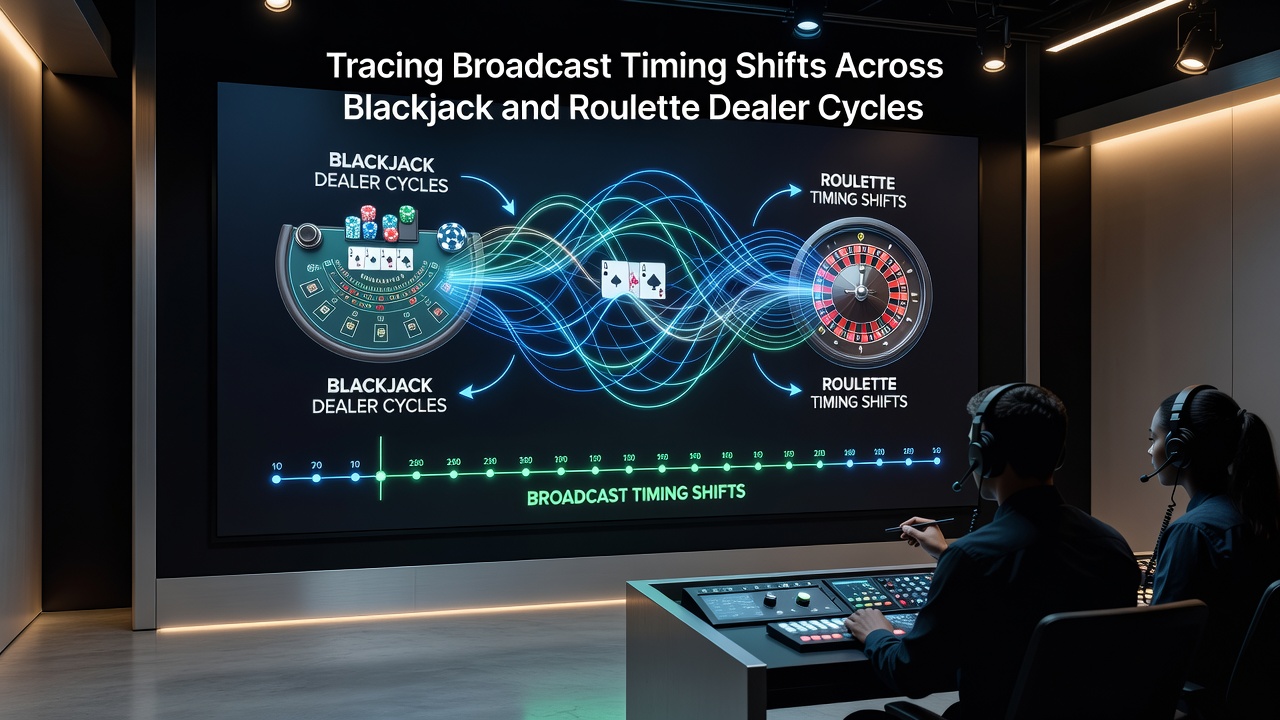
Tracing Broadcast Timing Shifts Across Blackjack and Roulette Dealer Cycles
Live casino broadcasts rely on precise coordination between dealer rotations and streaming outputs, and timing shifts emerge when blackjack tables change dealers every 20 to 30 minutes while roulette wheels maintain continuous spins interrupted only by brief payout intervals. These cycles generate measurable offsets in frame delivery and audio alignment that broadcast teams track through dedicated monitoring software. Observers note that such shifts accumulate across multi-table feeds because each table operates on independent rotation schedules dictated by house policy and regulatory requirements for game integrity.
Dealer Rotation Patterns in Live Environments
Blackjack dealer cycles typically follow fixed intervals set by the venue, with staff exchanging positions at marked times to reduce fatigue and maintain pace, whereas roulette dealers remain at the wheel for longer stretches interrupted by ball retrieval and chip resets. Research from gaming technology providers shows these differences produce staggered synchronization points that affect how cameras switch between overhead, side-angle, and close-up views. Data collected from high-volume studios in 2025 indicated average timing deviations of 8 to 12 seconds per rotation when no corrective buffering was applied, prompting engineers to implement dynamic latency compensation protocols.
Operators adjust broadcast schedules by logging exact changeover moments in centralized control systems, and these logs feed into automated cueing tools that realign video streams without interrupting the viewer feed. Studies conducted by the Nevada Gaming Control Board highlight that consistent documentation of rotation times correlates with fewer dropped frames during peak evening hours, when multiple tables transition simultaneously. Teams therefore maintain redundant timing servers that cross-reference dealer shift data against real-time stream metrics.
Synchronization Challenges Across Table Types
Roulette broadcasts demand continuous wheel coverage because the ball remains in play for extended periods, yet blackjack sequences involve rapid card dealings that finish in bursts, creating natural breakpoints where timing adjustments occur more readily. Engineers address these variances by deploying frame-accurate encoders that detect cycle endpoints through optical recognition of dealer hand movements and wheel sensors. When a blackjack dealer swap approaches, teh system anticipates a brief pause and preloads the next camera angle, reducing visible disruption to under two frames in most tested configurations.
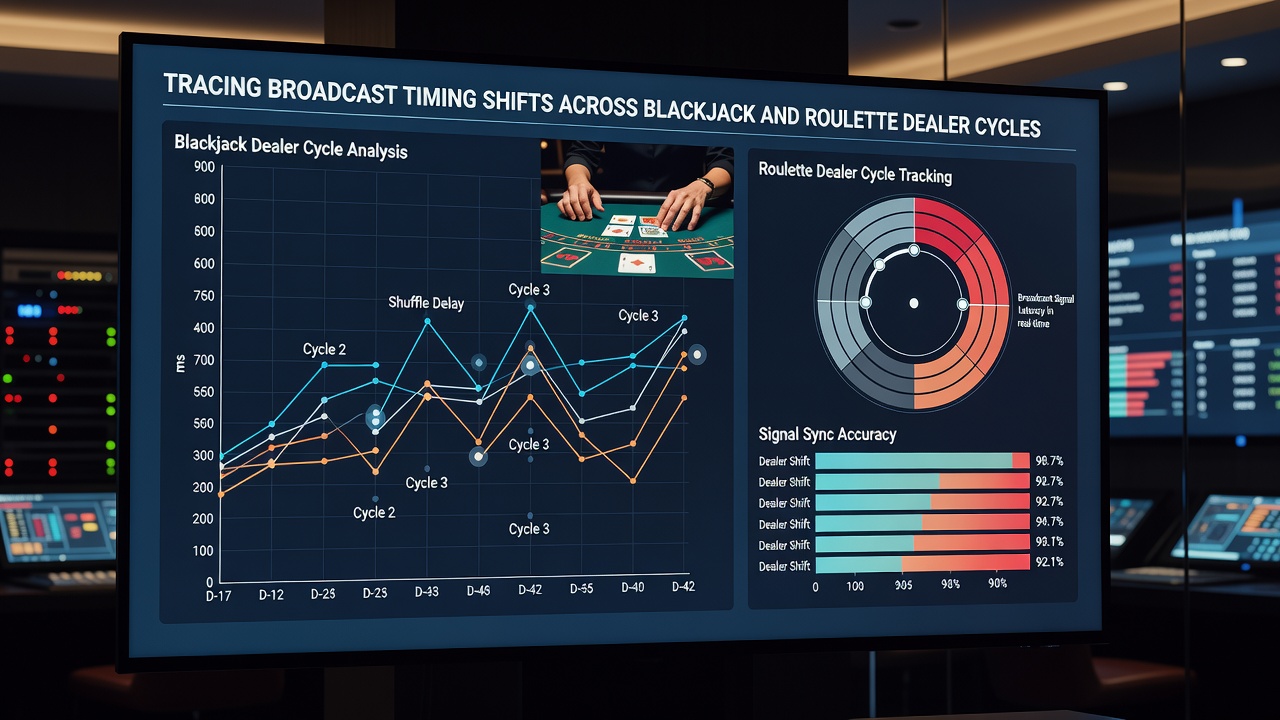
Multi-camera arrays further complicate the process because each lens carries its own processing delay, and combining feeds from separate tables requires unified timecode alignment. Industry reports from the Australian Communications and Media Authority note that venues adopting precision time protocol across all production equipment recorded a 40 percent reduction in audio-video drift during dealer transitions. Technicians therefore calibrate clocks daily and verify offsets against reference signals broadcast from the studio master clock.
November 2026 Technology Rollouts
Scheduled updates in November 2026 include wider adoption of AI-assisted timing prediction models that analyze historical rotation data to forecast shift points before they occur. These models integrate inputs from table sensors, dealer ID badges, and historical performance logs to generate preemptive stream adjustments. Early trials conducted at facilities in Macau showed that predictive buffering lowered average timing discrepancies from 11 seconds to under 4 seconds across mixed blackjack and roulette lineups. Regulatory bodies in multiple jurisdictions plan to evaluate these systems for compliance with broadcast quality standards before full-scale deployment.
Measurement Tools and Data Collection
Broadcast teams employ specialized logging software that records millisecond-level timestamps for every dealer entry and exit, and these records feed into analytics platforms that identify recurring offset patterns tied to specific table layouts or staff schedules. One documented case involved a European studio where roulette cycles consistently lagged blackjack rotations by 15 seconds on average, leading to targeted recalibration of encoder buffers for that venue. Such findings appear in aggregated industry reports compiled by the European Gaming Technology Association, which track timing performance metrics across dozens of live casino operations.
External audits verify that timing correction mechanisms operate within acceptable tolerances, and venues publish summary statistics that demonstrate compliance with streaming quality benchmarks. Analysts continue to refine detection algorithms that flag anomalies in real time, allowing immediate intervention when cumulative drift exceeds preset thresholds.
Conclusion
Tracing broadcast timing shifts across blackjack and roulette dealer cycles reveals a layered system of rotation schedules, sensor inputs, and corrective protocols that together sustain uninterrupted live streams. Continued refinement of measurement tools and the introduction of predictive technologies scheduled for late 2026 point toward further reductions in observable offsets. Data from regulatory and industry sources confirm that precise management of these cycles remains essential for maintaining broadcast integrity across expanding live casino networks.